|
|||||||||||
|
The
Vitruvian Man
|
|||||||||||
 |
|||||||||||
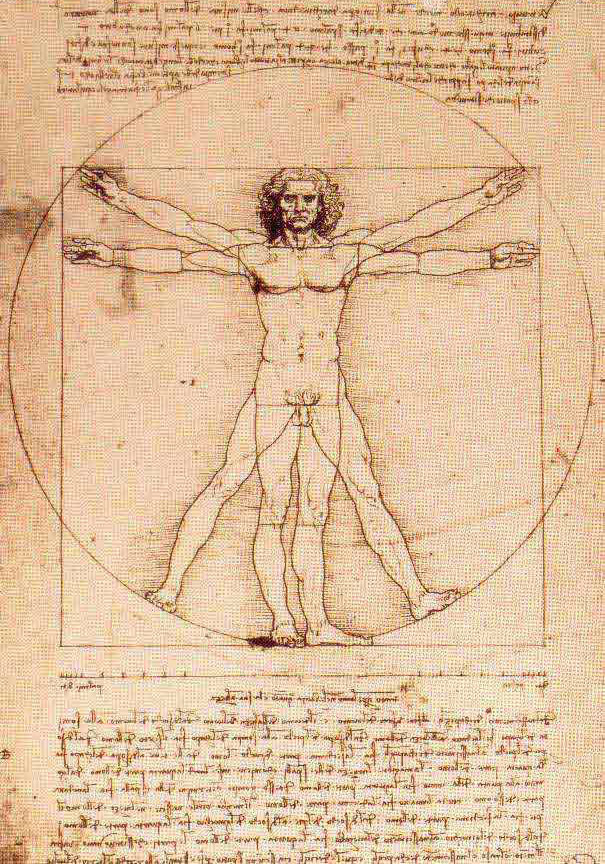
The reverse writing imbedded in Leonardo’s drawing is his translation into Italian from the Latin of MARCUS VITRUVIUS POLLIO, De Architectura, Book III of X, Chapter 1, "On Symmetry in Temples and in the Human Body." Vitruvius, an architect and military engineer during the Second Triumvirate, (following the death of Julius Caesar) and in the early reign of Augustus, was strongly influenced by the Greeks, particularly Hermogenes (c.200 BCE), and wrote on topics of style, proportion, ornamentation, the directions of streets, foundations and substructures, building methods and materials, ancient inventions, acoustics, and structural harmonics. |
|||||||||||
|
"The measurements of the human body are designed by Nature that 4 fingers make 1 palm, and 4 palms make 1 foot, 6 palms make 1 cubit; 4 cubits make a man's height. And 4 cubits make one pace and 24 palms make a man; and these measures he used in his buildings. "If you open your legs so much as to decrease your height 1/14 and spread and raise your arms till your middle fingers touch the level of the top of your head you must know that the centre of the outspread limbs will be in the navel and the space between the legs will be an equilateral triangle. "The length of a man's outspread arms is equal to his height. |
|||||||||||
|
"From the roots of the hair to the bottom of the chin is the tenth of a man's height; from the bottom of the chin to the top of his head is one eighth of his height; from the top of the breast to the top of his head will be one sixth of a man. From the top of the breast to the roots of the hair will be the seventh part of the whole man. From the nipples to the top of the head will be the fourth part of a man. The greatest width of the shoulders contains in itself the fourth part of the man. From the elbow to the tip of the hand will be the fifth part of a man; and from the elbow to the angle of the armpit will be the eighth part of the man. The whole hand will be the tenth part of the man; the beginning of the genitals marks the middle of the man. The foot is the seventh part of the man. From the sole of the foot to below the knee will be the fourth part of the man. From below the knee to the beginning of the genitals will be the fourth part of the man. The distance from the bottom of the chin to the nose and from the roots of the hair to the eyebrows is, in each case the same, and like the ear, a third of the face."
The Notebooks of Leonardo DaVinci, Vol. 1 pp. 182-3. Translation by Jean Paul Richter, 1883. [Dover Publications, New York.] Ten Books on Architecture, Vitruvius, translated by Morris Hicky Morgan.[Harvard University Press, 1914.] |
|||||||||||
|
Leonardo da Vinci links Museo
Scienzia, Milan Inventions
Leonardo
the Mathematician The
Codex Leicester Web
Museum, Paris - timeline Life,
Art, Inventions, & Drawings of Leonardo |
|||||||||||
|


